

Table of Contents
- What Defines a Retro Engagement Ring
- How to Identify Vintage Jewelry Eras: Art Deco to Mid-Century
- Signature Details: Old European Cut Diamonds, Filigree, and Rose Gold
- Best Practices for Buying Estate Jewelry Online
- Vintage Ring Restoration Tips and Common Repair Pitfalls
- Insurance, Appraisal, and Ethical Sourcing for Retro Rings
- Conclusion: Choosing a Retro Engagement Ring That Lasts
- Frequently Asked Questions
Last Updated: September 19, 2026
What Defines a Retro Engagement Ring
Retro engagement rings are pieces designed between roughly 1935 and 1950, defined by bold proportions, warm gold tones, and elaborate metalwork that set them apart from the delicate styles that came before. At SLV Fine Jewelry, the retro engagement rings in our collection share one trait: they were built to be noticed.
How to Identify Vintage Jewelry Eras: Art Deco to Mid-Century
Knowing how to identify vintage jewelry eras comes down to four signals: silhouette, metal, stone cutting, and construction method. Each period left fingerprints you can read with a loupe and a little patience, but the fastest way to date a piece is to look at how it was built, not just how it looks.
Art Deco Engagement Rings (1920s-1935)
Art Deco engagement rings favor geometry, symmetry, and contrast. Look for stepped motifs, calibre-cut gemstone accents, and platinum settings with precise milgrain edges. The stones are usually old European cut or old mine cut diamonds, which predate modern brilliant cutting. If the design feels architectural and cool-toned, you're likely looking at Deco.
The History of Retro Jewelry (1935-1950)
The history of retro jewelry begins where Deco ended. Platinum became restricted during wartime, so designers turned to rose gold, yellow gold, and palladium. Curves replaced straight lines. Scrollwork and hand-engraved surfaces replaced rigid geometry. Rings from this window feel warmer and more romantic than their Deco predecessors, and they typically feature larger, bolder center stones.
Mid-Century Modern Jewelry Styles (1950s-1960s)
Mid-Century Modern picks up where Retro leaves off. The silhouettes get cleaner, the gold gets yellower, and designers start experimenting with asymmetric settings, textured finishes, and mixed-metal combinations. Look for:
- Abstract or asymmetrical center settings rather than the symmetrical scrollwork of the Retro era.
- Brutalist and bark textures on the shank and shoulders, often hand-applied.
- Tiffany-style six-prong solitaires and other clean, elevated settings that pushed the diamond forward.
- Signed designer pieces from houses like Cartier, Van Cleef & Arpels, and David Webb, which command significant premiums.
The Four-Signal Dating Method
When a piece doesn't fit neatly into one era, run it through these four checks in order:
- Silhouette. Architectural and geometric = Deco. Curved and romantic = Retro. Clean and asymmetric = Mid-Century.
- Metal. Platinum-dominant = Deco. Rose or yellow gold-dominant = Retro. Yellow gold with texture = Mid-Century.
- Stone cut. Old mine cut = pre-1920s. Old European cut = 1900s-1930s. Transitional cut = 1920s-1940s. Modern brilliant = post-1950s (or a later replacement).
- Construction. Die-struck and hand-finished = Deco. Hand-assembled with visible solder seams = Retro. Cast with clean, uniform edges = Mid-Century or later.
Why Era Matters for Price
Era is not just a style label, it drives value. Fully period-correct pieces with original stones and documented maker's marks routinely command a premium over mixed-era pieces of similar appearance. If you're buying for investment, era accuracy is the single most important variable after stone quality. If you're buying to wear, era is a style decision, and a well-restored mixed-era ring can be the better value.
Signature Details: Old European Cut Diamonds, Filigree, and Rose Gold
Old European cut diamonds, platinum filigree, and rose gold form the three-part signature of retro design. Master these details and you can date most pieces on sight.
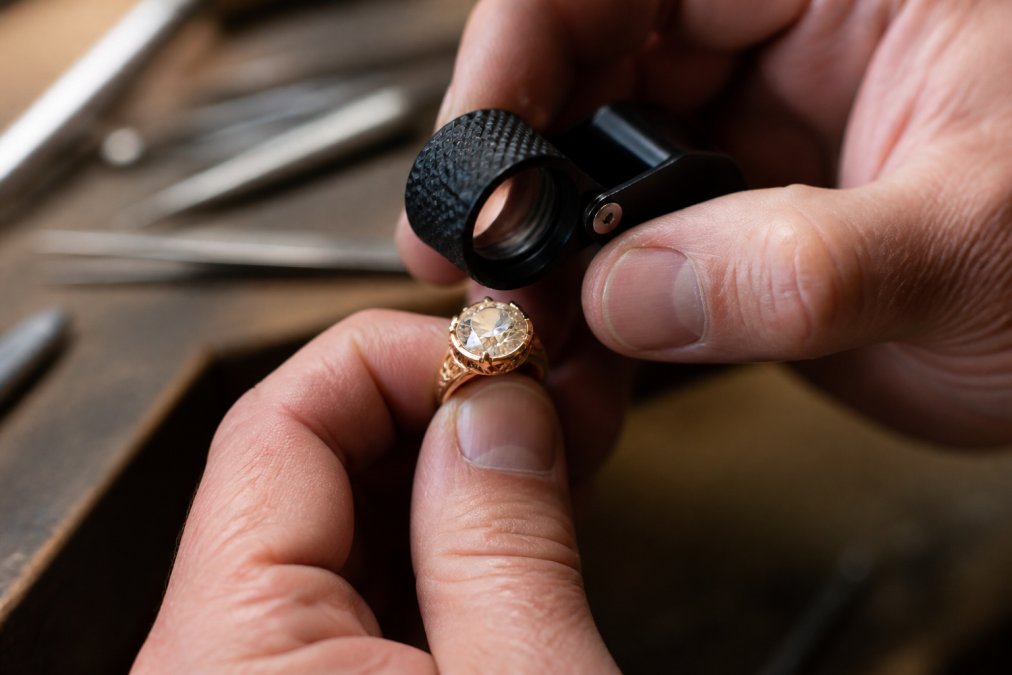
Old European Cut and Old Mine Cut Diamonds
Old European cut diamonds have a circular outline, a large open culet, and a small table that produces broad, chunky facets. Old mine cut stones are older still, with cushion-shaped outlines and higher crowns. Both were cut by hand, so no two are identical. That irregularity is the point.
Platinum Filigree, Milgrain, and Scrollwork
Filigree is openwork metal shaped into lace-like patterns. Milgrain is the row of tiny metal beads that borders a setting. Scrollwork is the flowing, hand-engraved linework that covers the shoulders and gallery of many retro rings. Together, these techniques required hours of bench work per piece.
Best Practices for Buying Estate Jewelry Online
The best practices for buying estate jewelry online start with documentation, not photography. A listing without a stated provenance, metal purity, and stone grading is a listing you should walk past, no matter how good the photos look.
- What is the stated metal content, and is it hallmarked or tested?
- Who graded the stones, and is the grading report from an independent lab?
- What restoration work has been done, and by whom?
Authenticating Vintage Jewelry and Reading Provenance
Authenticating vintage jewelry means verifying the metal, the stone cutting style, the construction method, and the hallmarks together. A single hallmark proves nothing on its own, since marks can be added later.
Vintage Ring Restoration Tips and Common Repair Pitfalls
Vintage ring restoration tips matter most before you hand a piece to anyone with a torch. Retro rings were built with solders and alloys that behave differently from modern metals, and a careless repair can erase decades of character.
Common pitfalls to watch for:
- Over-polishing. Aggressive buffing rounds off milgrain and softens engraving. Once it's gone, it cannot be restored.
- Wrong solder. Modern high-temperature solder on antique gold can discolor the surrounding metal permanently.
- Stone replacement without disclosure. Swapping an old European cut for a modern stone destroys value, even if the new stone is technically better.
- Resizing without reinforcing the shank. Thin antique shanks can crack if sized more than a step or two.
Insurance, Appraisal, and Ethical Sourcing for Retro Rings
Appraisal and insurance are the two steps buyers skip most often, and both protect you. But insuring a one-of-a-kind retro ring is not the same as insuring a mass-produced modern piece, and the difference trips up a lot of first-time vintage buyers.
Why Vintage Insurance Is Different
A modern ring has a catalog replacement path: if it's lost, the insurer buys the same SKU. A retro ring usually has no equivalent. There may be one comparable piece on the market, or none. That means your coverage has to be built around agreed value rather than a generic replacement formula.
Three terms you'll see on a policy:
-
Actual Cash Value (ACV). Pays what the piece is worth today, minus depreciation. Bad fit for vintage, the market may not have a comparable, and depreciation math is arbitrary for antiques.
-
Replacement Cost. Pays what it would cost to buy a comparable piece. Better, but only if a comparable exists.
-
Agreed Value. You and the insurer agree on a dollar figure up front, based on an appraisal, and that's what gets paid. This is the standard approach for one-of-a-kind vintage jewelry.
-
Loss, theft, and mysterious disappearance
-
Damage during repair or restoration
-
Stone loss from a worn or failed prong
-
Worldwide coverage, if you travel with the ring
The Appraisal Process
An independent appraisal establishes replacement value, which is the figure your insurer needs. Retail value and replacement value are not the same number, and conflating them leaves gaps in coverage.
For a retro ring, the appraisal should document:
- Metal content and purity, verified by test, not just by hallmark
- Stone measurements, estimated weights, and cutting style (old European, old mine, transitional)
- Any treatments, replacements, or restorations already performed
- Photographs of the piece from multiple angles, including the hallmarks
| Step | What It Covers | When To Do It |
|---|---|---|
| Independent appraisal | Agreed value, stone grading, condition report | Within 30 days of purchase |
| Scheduled rider or standalone policy | Theft, loss, mysterious disappearance, damage | Immediately after appraisal |
| Condition review | Prong wear, shank integrity, stone security | Annually |
| Professional cleaning | Safe cleaning for old cuts and filigree | Every 6-12 months |
| Re-appraisal | Updated market value | Every 3-5 years |
Ethical Sourcing and Sustainability
SLV Fine Jewelry specializes in old-cut natural diamonds and rare gemstones, and every piece we curate is selected for authenticity and long-term wearability, not just appearance.
Conclusion: Choosing a Retro Engagement Ring That Lasts
Buying a retro engagement ring is a decision about permanence. These pieces survived eight decades because someone cared for them, and the right one will outlast you too.
Frequently Asked Questions
What defines a 'retro' engagement ring compared to an antique one?
Retro refers specifically to the 1935-1950 period, while antique generally means 100+ years old. Retro rings feature bold proportions, rose gold, and sculptural gold work influenced by post-Depression and wartime design. Antique covers earlier eras like Victorian and Edwardian. Both are vintage, but retro is a distinct chapter in jewelry history with its own design language.
How can you verify the authenticity of a vintage engagement ring?
Look for era-specific hallmarks, check the cut of the diamond (old European and old mine cuts have distinctive open culets), and examine the metal work for hand-engraving rather than cast details. A reputable seller provides provenance documentation and an independent appraisal. When buying estate jewelry online, request high-resolution photos and ask specific questions about restoration history before committing.
Are retro engagement rings more durable than modern designs?
Many retro rings were built with substantial platinum or gold and hand-set stones, which can make them very durable. That said, 70+ year old prongs may have worn thin. A professional inspection and any needed restoration, such as retipping prongs or tightening settings, ensures the ring holds up to daily wear without losing its original character.
What are the most popular gemstone cuts for retro engagement rings?
Old European cut and old mine cut diamonds dominate the retro era, prized for their warm, candlelit sparkle. Natural sapphire accents, particularly in geometric or scrollwork settings, are also common. Purists prefer period-correct natural gemstones for authenticity.