

Table of Contents
- Why Antique Engagement Rings Are Worth the Search
- Antique Engagement Ring Eras: Art Deco, Victorian, and Edwardian
- How to Identify Antique Jewelry: Hallmarks, Cuts, and Provenance
- Benefits of Buying Estate Jewelry Over New Rings
- Resizing and Structural Integrity: What to Check Before You Buy
- Insurance, Appraisal, and Gemstone Certification
- Where to Find Antique Engagement Rings Near Me
- Frequently Asked Questions
Last Updated: September 19, 2026
Why Antique Engagement Rings Are Worth the Search
Antique engagement rings are pre-owned rings, typically more than 50 years old, valued for their historical craftsmanship and rare gemstones. At SLV Fine Jewelry, a single authenticated piece can offer unique character and craftsmanship. The search rewards patience: fewer pieces exist, but each carries provenance, hand-engraved detail, and old-cut diamonds no modern catalog can replicate.
Antique Engagement Ring Eras: Art Deco, Victorian, and Edwardian
Each era left a distinct fingerprint on design, and knowing them helps you date a piece before an appraiser does.
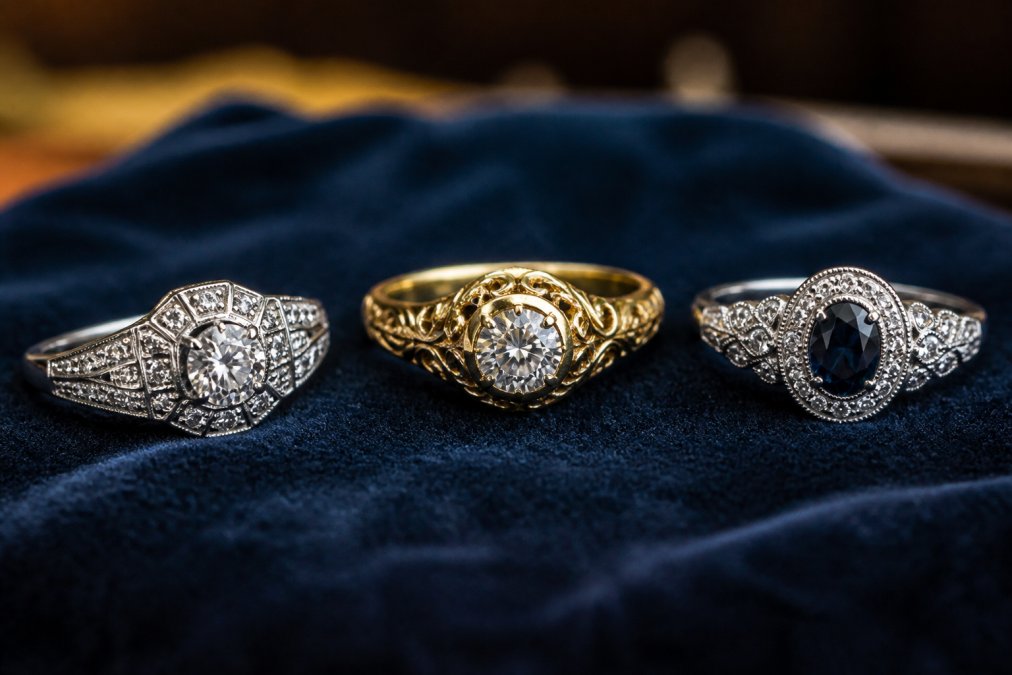
Art Deco (1920s-1930s): Geometric Lines and Platinum Settings
Art Deco rings favor bold geometry: stepped shoulders, octagonal frames, and platinum settings that hold color contrast between diamonds and natural sapphires. The style borrows from architecture, so expect symmetry over floral motifs.
Victorian and Edwardian: Filigree, Milgrain, and Hand-Engraved Details
Victorian era pieces lean romantic, with filigree scrollwork and hand-engraved gold. Edwardian style refines that into lighter, lacy platinum work edged in milgrain. Both reward close inspection: tool marks and uneven engraving usually signal handwork, not a modern cast.
How to Identify Antique Jewelry: Hallmarks, Cuts, and Provenance
Authentication starts with three checks: hallmarks, diamond cut, and provenance documents. A genuine piece usually shows all three, while reproductions typically fail at least one.
| Check | What to Look For | Red Flag |
|---|---|---|
| Hallmarks | Purity and maker stamps | Missing or machine-perfect stamps |
| Diamond cut | Old European or old mine cut | Modern brilliant proportions |
| Provenance | Appraisal or estate records | No documentation at all |
Old European Cut vs. Old Mine Cut Diamonds
Old European cut diamonds have a round girdle and open culet; old mine cut stones are cushion-shaped with higher crowns. Both predate modern brilliance, so they glow rather than sparkle. That softer light is exactly what collectors pay for.
Benefits of Buying Estate Jewelry Over New Rings
Estate jewelry offers rarity, craftsmanship, and sustainability that new rings can't match. Pre-owned pieces are already mined and crafted, which makes antique engagement rings a practical form of sustainable luxury. You also avoid mass production: most designs were made in small batches or by hand.
Resizing and Structural Integrity: What to Check Before You Buy
Resizing an antique ring is not the same as resizing a modern one, and the difference is metallurgical. Older alloys, particularly platinum from the 1920s and 1930s and lower-karat gold from the Victorian period, were formulated and worked differently than today's metals. Many antique bands were hand-forged and then hand-engraved, which means the pattern, the milgrain, and the filigree are integral to the metal rather than stamped on top of it. Cut the band and you cut the design.
Why Antique Bands Resist Resizing
Three structural realities drive the risk:
- Brittleness from age and repeated wear. Decades of flexing can create micro-cracks along the shank that are invisible until a jeweler applies heat. A torch that would safely soften a new band can propagate those cracks instantly.
- Thin, decorative shoulders. Art Deco and Edwardian rings often taper to shoulders under 1 mm thick. Removing or adding metal there weakens the exact area that carries the ring's visual identity.
- Engraved or milgrained surfaces. Re-sizing requires cutting, spreading or compressing, and re-soldering. Each step disturbs the engraving. A skilled bench jeweler can sometimes re-engrave to match, but the match is rarely invisible under a loupe.
Era-by-Era Resizing Limits
- Art Deco (1920s-1930s): Often limited to one size up or down. Geometric shoulders and channel-set stones distort permanently beyond that.
- Edwardian (1901-1915): Platinum and milgrain work tolerate roughly one size. Lacy openwork can crack if forced.
- Victorian (1837-1901): Highly variable. Simple gold bands may move two sizes; heavily engraved or gemstone-set pieces may not move at all without losing detail.
- Mid-Century (1940s-1960s): Generally the most forgiving, often two sizes, because alloys and construction were closer to modern standards.
What to Inspect Before You Commit
Bring a loupe or ask the seller for close-up photos and walk through this checklist:
- Prongs. Look for thinning, lifting, or re-tipped prongs. Re-tipping is normal maintenance; a fully rebuilt head may signal past damage.
- Shank wear. A shank worn thin at the bottom is a sign of heavy use and a candidate for cracking during resize.
- Shoulder cracks. Hairline fractures near where the shank meets the setting are the single most common reason a resize fails.
- Solder joints. Discolored or lumpy solder lines indicate prior repairs, ask what was repaired and when.
- Stone security. Gently rock each stone. A loose old European cut is a sign the setting has already been stressed.
Alternatives When Resizing Isn't Safe
If the ring can't be safely resized, you still have options:
- Sizing beads or a spring insert. Reversible, non-destructive, and ideal for rings worn occasionally.
- A hinged shank. A jeweler can add a hidden hinge and clasp so the ring opens over the knuckle without altering the original band.
- Wear it on a different finger. The simplest answer, and often the right one for a collector piece.
- Reset the stone. If the setting is the problem, moving the stone into a new mounting preserves the diamond while retiring the fragile band.
Insurance, Appraisal, and Gemstone Certification
Antique jewelry is one of the hardest categories to insure well, because the piece is often irreplaceable. A modern solitaire can be duplicated from a catalog; a hand-engraved Edwardian ring with an old mine cut diamond cannot. That distinction drives every decision about appraisal, documentation, and coverage.
Appraisal vs. Certification: Two Different Documents
Buyers often conflate these. They serve different purposes and you generally need both.
- An appraisal is a valuation report prepared by a qualified appraiser. It states what it would cost to replace the piece in the current market. Insurers use this number to set coverage limits.
- A gemstone certification (also called a grading report) is issued by a gem laboratory and describes the stone itself: identity, measurements, cut, color, clarity, and, critically for antiques, whether it has been treated. Common labs include GIA and AGS. A certification does not state a dollar value.
Why Antique Pieces Are Harder to Insure
Standard homeowners and renters policies typically cap jewelry coverage at a low threshold and cover only named perils, theft, fire, and a short list of others. They usually exclude the most common losses: mysterious disappearance (lost, misplaced, or unaccounted for) and damage from normal wear.
The Appraisal Process, Step by Step
- Get an independent appraisal. Use an appraiser who is not the seller. A seller-issued appraisal is a conflict of interest and many insurers will not accept it.
- Ask for the right kind of value. Request a replacement-value appraisal for insurance purposes. Fair market value and liquidation value are different numbers used for different situations (estate settlement, resale) and are usually lower.
- Document the piece thoroughly. Photograph it from multiple angles, top, side, underside of the setting, hallmarks, and any engraving. Include a ruler or coin for scale.
- Keep the paperwork together. Store the appraisal, certification, photos, and original receipt in one place, and keep a digital copy.
- Submit to your insurer and schedule the piece. Coverage begins when the insurer adds it to the policy, not when the appraisal is written.
Timing and Renewal
Most insurers expect an appraisal within a short window after purchase, often within 30 days, to bind coverage. After that, appraisals are typically refreshed every two to five years, or whenever the market for comparable pieces shifts meaningfully. Antique and estate jewelry values can move with collector demand, so a stale appraisal can leave you underinsured.
What to Do If the Piece Is Damaged
If an antique ring is damaged, do not have it repaired before contacting the insurer. Insurers generally want to see the piece in its damaged state, and some will send it to their own jeweler for evaluation. Repairing first can void the claim. If the piece is a total loss, the settlement is based on the appraised replacement value, which is why an accurate, current appraisal is the single most important document you own.
Where to Find Antique Engagement Rings Near Me
Specialty dealers and curated online collections are common sources for antique engagement rings.
Frequently Asked Questions
What is the difference between vintage and antique engagement rings?
Antique engagement rings are at least 100 years old, placing them in eras like Victorian, Edwardian, or Art Deco. Vintage rings are typically 20 to 99 years old. Both differ from pre-owned modern pieces. Age affects the diamond cuts you'll find (old mine cut and old European cut are common in antiques), the metalwork style, and how the ring can be resized. Knowing the distinction helps you search with realistic expectations and ask the right questions about provenance and restoration history.
Are antique engagement rings a good investment?
Investment-grade antique rings share traits with any valuable jewelry: rare gemstones, authenticated provenance, and quality craftsmanship. Old European cut diamonds, natural sapphires, and hand-engraved platinum settings hold value well because they cannot be reproduced exactly. That said, most buyers choose antiques for wearability and character rather than pure financial return. A professional jewelry appraisal establishes replacement value for insurance, which matters more than resale speculation for everyday owners.
How do I verify the authenticity of an antique diamond?
Start with hallmarks on the setting, which indicate the metal content and sometimes the maker. A gemstone certification from an independent lab confirms the diamond's identity and grade. For old cuts, look for the distinctive open culet and higher crown of old mine cut and old European cut stones, which modern brilliants lack. A reputable jeweler can examine setting integrity, check for synthetic or treated stones, and document jewelry provenance. Always ask for documentation before purchasing.
How much do antique engagement rings cost?
Pricing depends on the era, gemstone quality, metal content, and rarity. Pricing depends on the era, gemstone quality, metal content, and rarity. Restoration history also affects value. Because every antique piece is unique, there is no single price range. We recommend booking an appointment to discuss specific pieces and obtain a quote.
Finding an antique engagement ring means balancing rarity against risk. SLV Fine Jewelry removes that risk through expert restoration, a curated collection of old-cut natural diamonds, and customization options that modernize heirloom stones without erasing their character. Get started with SLV Fine Jewelry and book an appointment to find a piece made for generations.